Table of Contents
- 01. The Bias Problem Nobody Admits
- 02. You Have No Idea What AI Knows About You
- 03. When AI Is Wrong, Nobody Pays the Price
- 04. AI Is Quietly Changing What You Think and Believe
- 05. The Environment Nobody Talks About
- 06. AI Creativity Is Stealing From Real People
- 07. The ‘Move Fast’ Mentality Is Genuinely Dangerous
- ✅ So What Can You Actually Do About This?
- ❓ Frequently Asked Questions
I have used and tested more than 100 AI tools, read numerous research papers published by industry experts, and attended several tech conferences with leading experts. After all this, I have realized one thing that truly disappoints me:
| 💬 The Honest TruthThe loudest conversations about AI ethics are happening in the wrong rooms, about the wrong problems, at the wrong time. |
I asked my friend, who is around 45 years old, about AI ethics. Without thinking for even a second, he immediately said,“These are future problems. Why should we talk about them now?”
And honestly, this is exactly how most people think. They believe that AI ethics issues can be dealt with later, when AI becomes more advanced.
But the reality is, they are wrong.Because these are not future problems — they are already happening right now.
In this blog, I want to walk you through the 7 AI ethics issues that I believe deserve far more attention than they are getting in 2026.
No jargon. No corporate speaking. Just honest, direct truths about where AI is going wrong — and why it matters to you personally.
1. The Bias Problem Nobody Admits
Every major AI company says their models are fair. Very few of them can prove it.
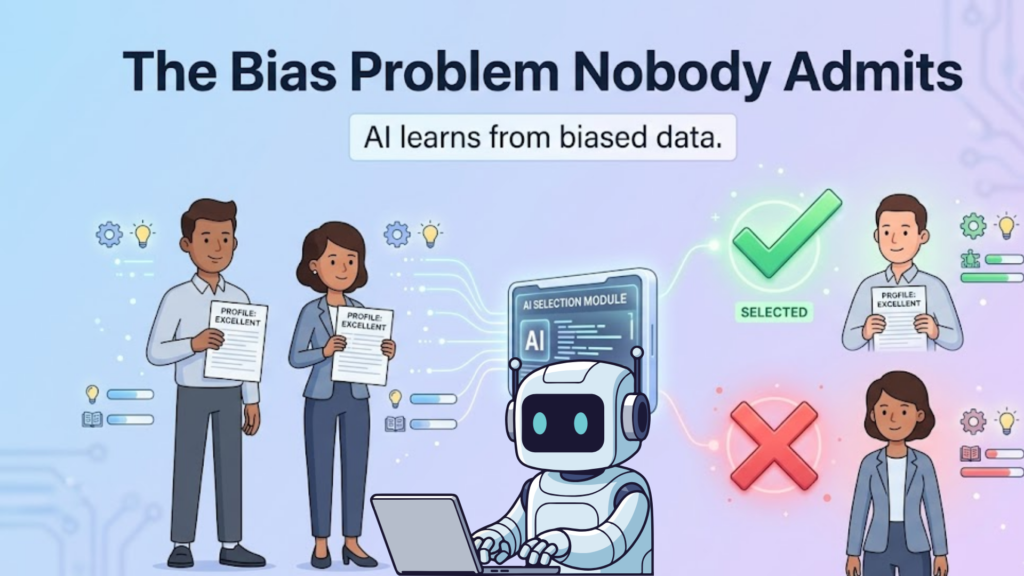
Here is the uncomfortable reality: AI systems learn from human data. And human data is full of hundreds of years of bias — racial, gender, socioeconomic. When you train an AI on that data without carefully correcting for it, the AI does not just inherit that bias. It amplifies it.
I have seen this play out in ways that genuinely shocked me. Facial recognition systems in the US have been shown to misidentify dark-skinned faces at rates significantly higher than light-skinned faces.
AI hiring tools trained on historical data — where most senior roles were held by men — have quietly filtered out women’s resumes.
For example, there is a company which is 22 years old. When a company hired in the past, they chose more men, and rejected women.
It doesn’t matter whether women are the more qualified candidate, and now they want to train ai to hiring, so they will use their data to train AI for that purpose, Now AI will do the same when it selects candidate for the company, AI will choose men most, not matter women are more qualified
And the scariest part? Most of the time, nobody even realizes it is happening.
| AI Bias — Real Examples | Impact |
| Facial recognition error rates for dark-skinned women | Up to 35% vs under 1% for white men |
| Amazon scrapped AI hiring tool (2018) | System penalized resumes with word ‘women’s’ |
| AI loan approval systems in the US | Black applicants denied at higher rates than white |
| AI healthcare tools in UK hospitals | Undertreated darker-skinned patients in pain assessment |
The fix is not simple. But the first step is honestly acknowledging the problem exists — which many companies are still not willing to do.
2. You Have No Idea What AI Knows About You
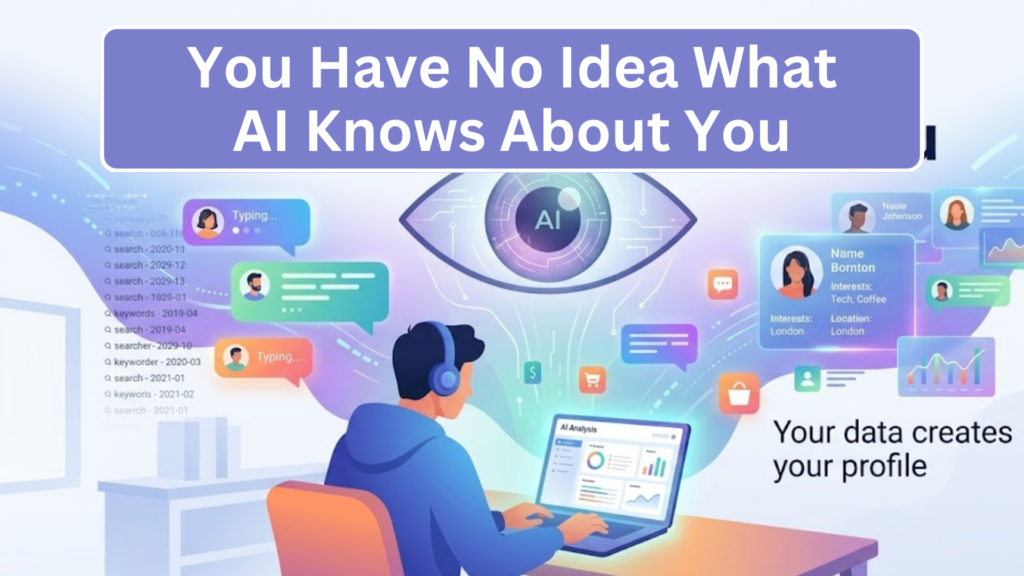
Every time you use an AI tool, you are likely sharing more data than you realize.
Think about the last week. How many times did you type something into ChatGPT? How many photos did you edit with an AI app?
How many emails did you write with an AI assistant? Every one of those interactions creates data — data that can potentially be stored, analyzed, and in some cases, used to train future AI models.
Suppose I ask chatgpt about how to make money online, how to learn to code, or suggests me the top 10 clothes for me I want to buy now, or make a diet plan for me,
Chatgpt doesn’t even answer you it creates my profile. He thinks that I’m interested in this, so to the point it creates your profile,
Let’s suppose my friend asked gemini to make this photo professional or edit my photo for my LinkedIn profile. Gemini will do as he asked, but he is giving his face, expressions, style. Ai can recognize his face, understand his appearance pattern.
You normally think, I don’t share my number, but from your questions, writing style, interest, I can guess more about you which you can believe.
Yesterday I saw my friend. He was searching into AI:
“Work from home jobs”
“Cheap rented apartments”
“How to save money fast”
From this, AI can understand that that person is financially weak and wants a job to survive.
This matters more than people think. In 2025, researchers found that some AI systems were capable of reconstructing surprisingly accurate personal profiles from what seemed like harmless, unrelated conversations.
You do not need to share your name, your address, or your phone number. Your writing patterns, your questions, your concerns — they paint a picture of you that can be more revealing than you would ever voluntarily share.
The ethics problem here is not just what companies do with your data today. It is the fact that there is almost no transparency about what is being collected, how long it is kept, who can access it, and what it might be used for in five years.
The GDPR in Europe and the CCPA in California give some protections. But most AI users around the world have essentially zero rights over their AI-generated data trail.
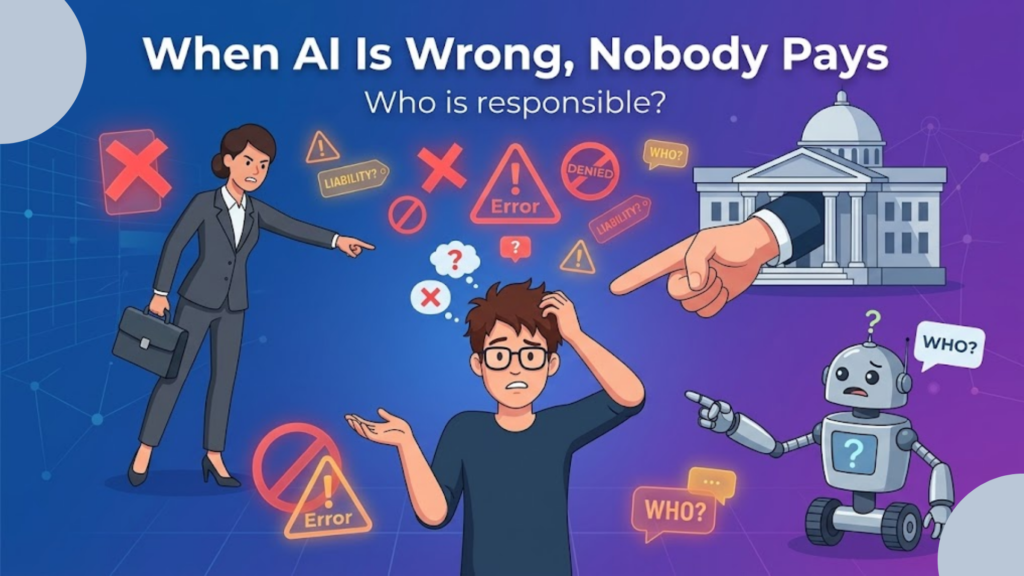
3. When AI Is Wrong, Nobody Pays the Price
Here is a question I want you to really sit with:
| ❓ Think About This: If an AI system makes a wrong decision that ruins your life — denies your medical claim, gives you incorrect legal information, wrongly flags you as a fraud risk — who is actually responsible? |
The answer, in 2026, is largely: nobody.
This is the accountability gap, and it is one of the most serious ethical problems in AI today. AI systems are making consequential decisions — decisions about your healthcare, your finances, your employment — and when they get it wrong, there is often no clear legal framework for who is liable.
The AI company says the tool is just a tool and the human should have checked the output. The business using the AI says they trusted the technology.
The regulator is still writing the rules. And the person whose life got impacted is left with no clear path to justice.
Here’s the proof. Australia’s govt has launched an AI system (the“Robodebt” scandal) for financial help checking debts, but instead of a welfare, the AI system matches people’s data wrongly and sends debt notices to millions of people.
As a result, thousands of people suffer financially and mentally, and some people go into depression, and according to reports, some people are killed by suicide.
Real situations where this is happening right now:
• Medical AI tools giving incorrect dosage recommendations that doctors accept without double-checking
• AI content moderation wrongly banning accounts or flagging innocent posts as dangerous
• AI credit scoring systems lowering people’s scores based on flawed data with no appeal process
• Autonomous vehicles being in accidents where no human driver is legally at fault
The EU AI Act is trying to address this with new liability rules. The US is debating similar legislation. But as of 2026, the gap is very much open — and real people are falling through it every day.
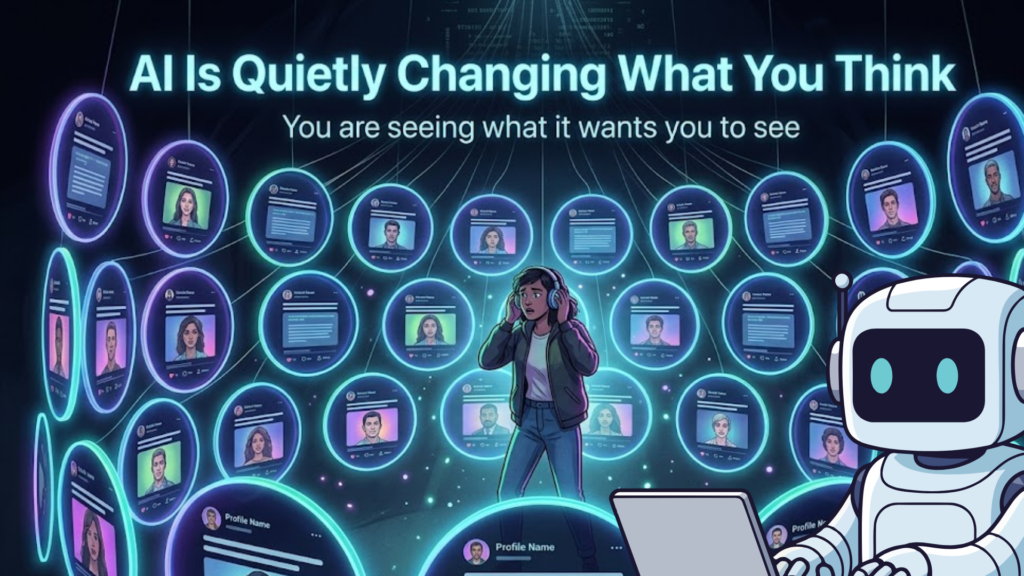
4. AI Is Quietly Changing What You Think and Believe
This one is subtle. But in my opinion, it might be the most dangerous problem on this list.
Every time you use a search engine powered by AI, every time you scroll a social media feed curated by AI, every time a content recommendation algorithm decides what you watch next — an AI is making micro-decisions about what information you see and what you do not.
These systems are not designed to show you the most accurate information. They are designed to keep you engaged. And engaged usually means emotionally activated — angry, scared, excited, outraged.
CASE 1: I want you to pay attention to this AI reality: let’s say you watch political content on YouTube, Instagram, Facebook, their algorithms will suggest the same content you like, but you think people are thinking the same, but not, actually. In reality, you are inside an echo chamber where you are only exposed to one side of the narrative.
CASE 2: A well-known real-world example is the Cambridge Analytica scandal, you might not know. In this case, user data was used to deliver highly targeted political content designed to influence people’s emotions and opinions.
It proves that AI+Data can influence people’s thinking.
Over time, this shapes your view of reality in ways that are extremely difficult to detect. You start to think the world is more dangerous than it is. Or that one political side is obviously right. Or that certain people cannot be trusted. Not because the evidence says so — but because the AI kept showing you content that pushed you in that direction.
| 📊 The Numbers Are Alarming: A 2025 study found that AI-curated content feeds increased polarization measurably in just 3 weeks of exposure. Participants did not realize they were being influenced. They genuinely believed their new views came from their own thinking. |
The ethical issue here is consent. Nobody signed up to have their worldview slowly reshaped by a profit-maximizing algorithm. Nobody was told that was happening. And very few people even know it is happening to them right now.
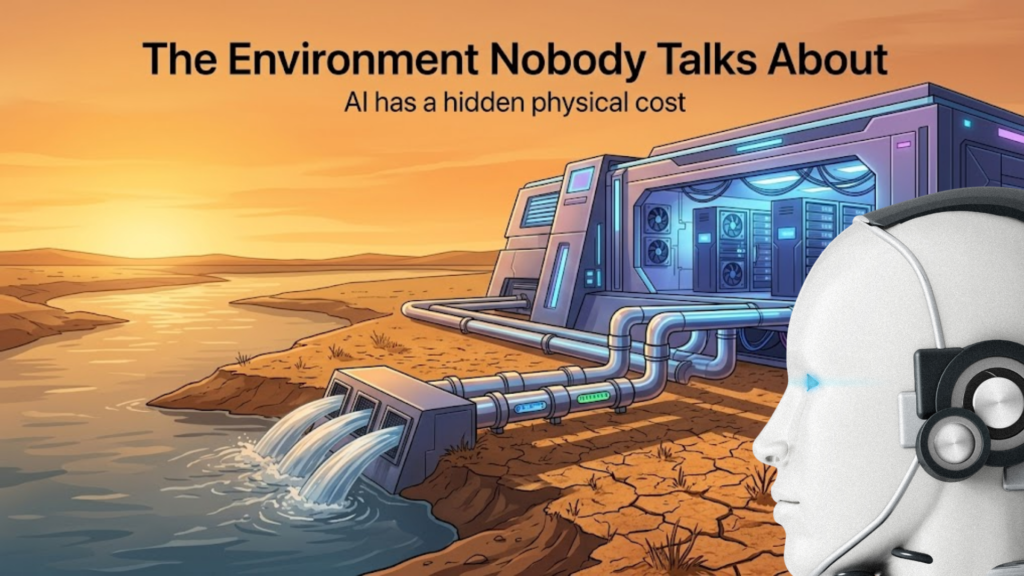
5. The Environment Nobody Talks About
Ask most people what the ethical issues with AI are. They will say bias, privacy, job losses. Almost nobody mentions the environmental cost. And yet it is enormous.
Training a single large AI model like GPT-4 is estimated to produce as much carbon dioxide as five cars over their entire lifetimes. Running ChatGPT for one day consumes roughly 500,000 liters of water for cooling data centers. 500,000 liters of water means more than 1,000 people’s daily drinking needs will be fulfilled.
As of 2026, the global energy consumption of AI is growing faster than most renewable energy expansion can compensate for.
| AI Environmental Cost | Estimated Impact |
| Training one large language model | ~300 tons of CO2 (equiv. 5 cars’ lifetime) |
| ChatGPT daily water consumption | ~500,000 liters for cooling |
| Global AI energy use growth (2023-2026) | Up ~40% year on year |
| Google’s carbon emissions (2024) | Up 48% due to AI data centers |
I am not saying we should stop using AI. I use it every day. But the ethics of AI cannot be separated from its physical footprint.
When AI companies present their tools as clean and digital and weightless, they are hiding a real environmental cost that disproportionately affects communities near data centers and in climate-vulnerable countries.
And the most important data centers are not just virtual but based on physical locations. For these, companies use heavy dose of electricity and water, and due to this, it puts pressure on local communities. And sometimes in nearby areas, water shortages have been reported.
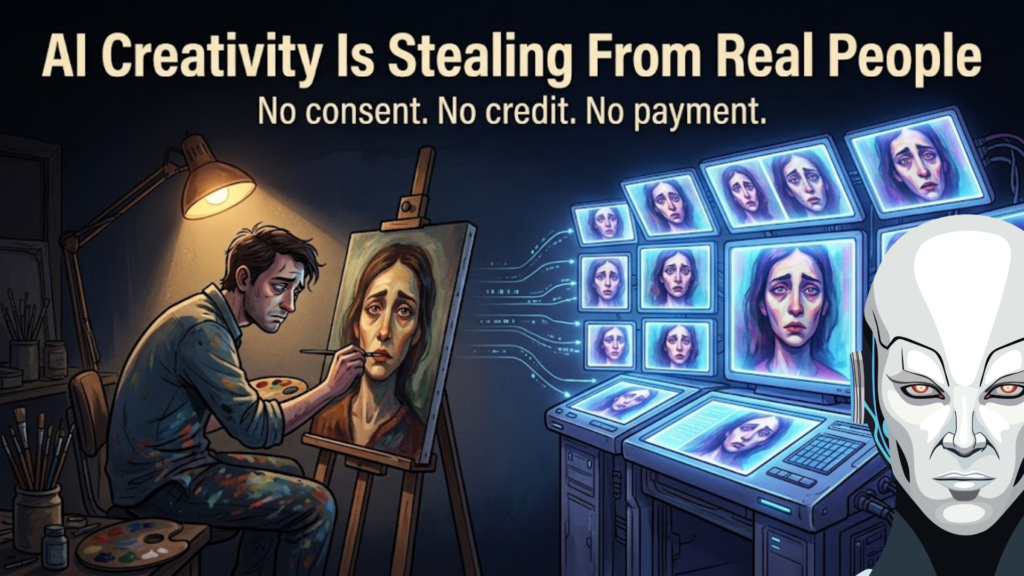
6. AI Creativity Is Stealing From Real People
I will be direct here because I think this one gets a lot of dishonest treatment.
When AI generates an image in the style of a living artist, or writes music that sounds like a specific composer, or produces writing that mirrors a journalist’s voice — it is doing so because it was trained on that person’s work without their permission and without compensating them.
In December 2023, The New York Times (NYT) filed a lawsuit against OpenAI and Microsoft, claiming the companies used their millions of articles without their permission to train AI models like ChatGPT. This problem wasn’t limited to artists but affected journalists too.
This is not a hypothetical future concern. It is happening right now at massive scale. Writers, illustrators, photographers, musicians — many of them have discovered their entire professional body of work was scraped from the internet and fed into AI training datasets. They were never asked. They were never paid. They were never even told.
| 🎨 The Human Cost: In 2025, the Getty Images lawsuit against AI image generators revealed that over 12 million copyrighted photographs were used without permission in training data. The case is still working through the courts — but the damage to professional photographers has already happened. |
Some people argue that AI learning from human work is just like a human artist learning by studying other artists. In 2023–2025, thousands of artists protested and ran campaigns on “Don’t train AI in our work without consent.”
I have thought about this argument for years and I genuinely disagree. When a human studies other artists, they bring their own lived experience, their own perspective, their own original thinking to what they create.
An AI produces output by statistically predicting what should come next based on patterns in other people’s work. It is fundamentally different.
The ethics of AI creativity require honest conversations about consent, compensation, and credit. These conversations are finally starting — but not fast enough for the creators who are already losing their livelihoods.
7. The ‘Move Fast’ Mentality Is Genuinely Dangerous
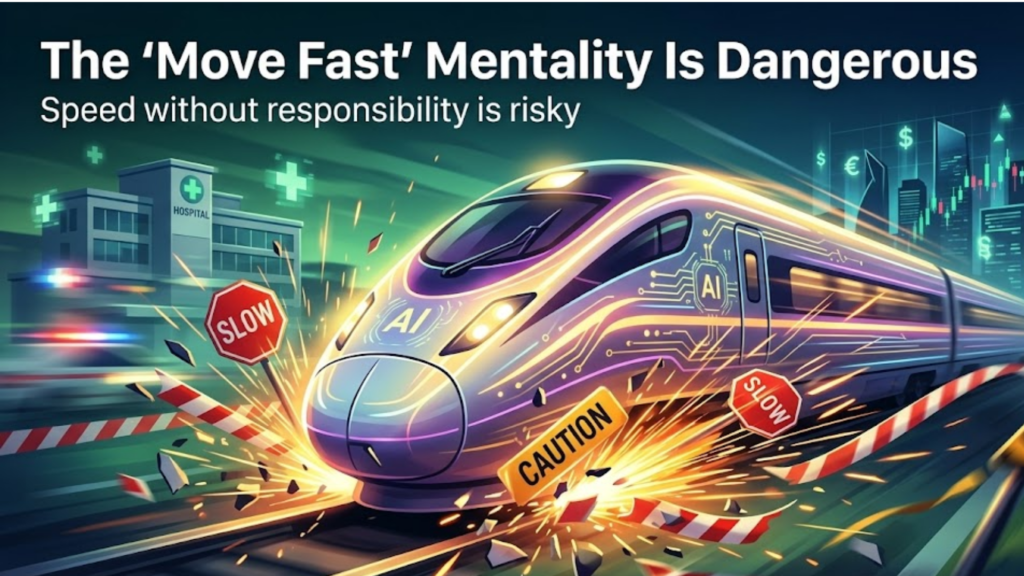
The tech industry has a motto that became famous in Silicon Valley: move fast and break things.
For social media apps, this mentality gave us platforms that moved too fast and ended up breaking democracy in ways nobody fully anticipated.
For AI — which is being embedded into healthcare, criminal justice, financial systems, and military technology — moving fast and breaking things could be catastrophic.
As you know in healthcare, even a very small mistake by AI can put lives at risk.
Right now, AI companies are racing each other to release models faster and faster. The pressure to ship before a competitor does has led to systems being deployed before they are fully understood.
Before their failure modes are mapped. Before their potential for harm has been properly studied.
I watched this happen in real time when early AI medical diagnostic tools were deployed in hospitals before independent safety verification.
When AI hiring tools went live at scale before anyone audited them for bias. When AI content moderation was scaled up before the edge cases were understood.
| 🚨 The Stakes Are Different Now: When a social media app moves too fast and breaks something, you get a bad product experience. When an AI system embedded in a hospital moves too fast and breaks something, patients can die. The ethics of speed are not the same at every level of risk. |
The EU AI Act has introduced the concept of ‘high-risk AI systems’ that require more careful verification before deployment.
This is the right direction. But regulation moves slowly. And the companies building these tools have strong financial incentives to move faster than the rules can keep up.
So What Can You Actually Do About This?
I am not going to end this post with the usual vague advice about staying informed and hoping governments figure it out. Here are things you can genuinely do right now.
As an individual:
1. Read the privacy policy before using any new AI tool — especially where your data is stored
2. Be skeptical about AI-generated content you read online — always check the original source
3. Notice when you feel strongly about something you read online — ask yourself if an algorithm might be influencing you
4. Support creators directly — buy from artists and writers rather than using AI replacements for their work
5. When AI makes a decision that affects you and seems wrong — appeal it, report it, push back
As a professional or business owner:
6. Before deploying any AI tool, ask how it handles bias and who is accountable when it makes mistakes
7. Do not outsource judgment to AI on high-stakes decisions — keep a human in the loop
8. Be transparent with your customers about where and how you use AI
9. Pay fair rates to the humans whose creativity you benefit from — do not cut corners with AI-generated work
Final Thoughts
I have been thinking about these issues for years. And the thing that strikes me most is not how complicated they are — it is how simple the core ethical principles actually are.
I use it daily, thinking this is powerful for doing work in less time, but using AI their responsibility also big.
Treat people fairly. Be honest about what you are doing and why. Take responsibility when things go wrong. Do not harm people in pursuit of profit. Do not take what is not yours.
These are not radical ideas. They are basic human values that we all already agree on. The challenge is applying them consistently to technology that moves faster than our ethical frameworks can keep up with.
The AI industry is not full of evil people. Most of the people building these tools genuinely believe they are making the world better. But good intentions do not automatically produce ethical outcomes. That requires deliberate, ongoing effort — from developers, from companies, from governments, and from us as users.
The problems I described in this post are not inevitable. They are choices. And choices can be changed.
But only if enough people know they exist.
Now you do. Next time when you use AI, ask these 4 questions to yourself: Is this system fair? Is it transparent? If something goes wrong, who will be taking responsibility?
Frequently Asked Questions
The biggest AI ethics issues in 2026 include algorithmic bias in hiring and healthcare, data privacy concerns, lack of accountability when AI makes mistakes, AI’s influence on public opinion through recommendation algorithms, environmental costs of AI training, copyright violations in AI creative tools, and the dangers of rushing AI deployment without proper safety checks.
Yes, absolutely. AI bias is one of the most documented problems in the field. Facial recognition systems have been shown to misidentify people of color at much higher rates than white faces. AI hiring tools have filtered out qualified candidates based on gender. Healthcare AI has shown racial disparities in pain assessment. These are not theoretical problems — they are happening to real people right now.
AI affects privacy in multiple ways. AI tools collect and store your conversation data, often for extended periods. AI systems can build detailed personal profiles from seemingly unrelated data points.
This is one of the most unresolved ethical questions in AI today. In 2026, there is still no clear legal framework in most countries for AI liability. AI companies often argue the tool is just a tool. Businesses using AI tools often defer to the technology. The person harmed frequently has no clear path to recourse. The EU AI Act is beginning to address this — but the accountability gap is very much still open.
AI has a significant environmental footprint that is rarely discussed. Training large AI models produces substantial carbon emissions — equivalent to the lifetime emissions of multiple cars. Running these models at scale consumes enormous amounts of electricity and water. As AI use grows, the environmental impact is growing with it. This does not mean AI is wrong to use — but the environmental cost deserves honest acknowledgment.
The core of the AI copyright debate is whether AI companies had the right to train their models on creative works — books, articles, images, music, code — without the permission of the creators and without compensating them. Many creators argue this is straightforward theft of their work. AI companies argue it falls under fair use. Courts in the US and UK are still working through these cases, but the ethical question is already settled for many creators whose livelihoods have been affected.